How Long Does a Restaurant or Bar Fit-Out Take?
On most restaurant and bar jobs the building work isn't what sets the opening date. The approvals are, and each one has a fixed minimum wait. Here's the order to tackle them in.
Ask how long a restaurant, café or bar takes to fit out and most people think about the builders: the strip-out, the new kitchen, the bar counter, the decorating. On a lot of jobs that isn't what decides the opening date. The approvals do. Planning, building regulations, a premises licence and food business registration each come with a fixed minimum wait, and the trick is to get them all moving early enough that they finish before the building work does.
Which of them your job needs depends on what's changing. A refresh in the same layout might need none of the planning side. Turning a shop into a bar can need all four.
The fixed waits, in England
- Planning application
- Most decided within 8 weeks
- Building regulations, full plans
- Decision within 5 weeks, or 2 months with your consent
- New premises licence
- At least 28 days for representations
- Food business registration
- At least 28 days before you open
- Building control completion certificate
- Usually within 8 weeks of finishing
Three kinds of job, three different timelines
A refresh in the same layout. New bar front, back-bar, seating, lighting and finishes, with the kitchen staying where it is and the use of the building unchanged. This is mostly building time. Some of the trades still fall under building regulations, for example new electrics, plumbing, fixed air conditioning or heating, but if those trades are registered with a competent person scheme they can certify their own work and you don't need to apply yourself.
A new layout or a new commercial kitchen. Moving the kitchen or adding toilets means new drainage, plumbing and electrics, which brings in building regulations properly, so drawings and a full plans application come first. The kitchen itself has to meet food hygiene standards (more on those below), gas appliances need a catering-qualified engineer, and a new extraction flue on the outside of the building can need planning permission. Councils looking at a new flue may ask for noise and odour details and attach conditions, so it's worth raising early.
A change of use. Restaurants and cafés are in Use Class E, the same class as shops and offices, and a change within one class isn't treated as development. Pubs, wine bars and hot food takeaways are outside it, in a class of their own, so turning a shop or office into one of those generally needs planning permission, as does most outside building work that goes with a change of use. The Planning Portal's advice is to check with the council before you buy or lease a unit, and that's where an 8-week wait can be planned for rather than discovered.
The order to do things in
The approvals don't have to queue behind each other. Planning, building regulations and the licence can all be in progress at once, while the design is finished and the joinery is made.
Check the use class before you sign the lease
Restaurants and cafés sit in Use Class E alongside shops and offices. Pubs, wine bars and hot food takeaways are sui generis, a class of their own. Moving a unit from one class to another generally needs planning permission, and most decisions take up to 8 weeks, so this is the first thing to find out.
Get drawings done and apply for the approvals together
Planning permission, if it's needed, and building regulations approval can run at the same time. A full plans building regulations application gets a decision within 5 weeks, or 2 months if you agree to the longer period.
Apply for the premises licence early if you'll sell alcohol
The application goes to the council's licensing team. A notice has to be displayed at the premises for at least 28 consecutive days and published in a local paper, and there's a period of at least 28 days for representations. If none are made, the council must grant the licence. If relevant representations are made, there's a hearing.
Build to food hygiene standards from the first fix
Floors and walls in food areas need to be smooth and washable, with enough hand-wash basins with hot and cold water, separate food sinks where needed, and adequate ventilation, lighting and drainage. These are far easier to get right while the walls are open than after.
Register the food business at least 28 days before opening
Registration is with the local council, it's free and it can't be refused, but it has to be done at least 28 days before you start trading. The council's food safety officers can then inspect, usually without an appointment.
Complete the fire risk assessment and sign-off
Whoever has control of the premises has to carry out a fire risk assessment before the public come in. Building control usually issues the completion certificate within 8 weeks of the work finishing, as long as it complies.
What the kitchen has to meet
Before you open, the council's food safety officers will expect a kitchen they can pass. The rules are about the room as much as the food: floors and walls in food areas smooth, washable and in good repair; ceilings easy to clean; enough hand-wash basins with hot and cold running water; a separate sink for washing food where it's needed; adequate ventilation, lighting and drainage; and screens on any opening windows. The inspection leads to a food hygiene rating from 0 to 5, which is published.
Nearly all of that is decided at first fix, when the pipework, drainage and wiring go in. Putting the hand-wash basins and drainage runs on the drawings is straightforward. Adding them once the walls are tiled means taking work back out.
The licence, if you're selling alcohol
A new premises licence is applied for through the council's licensing team. For venues in Scarborough, Whitby and the rest of North Yorkshire, that's North Yorkshire Council. Alongside the application, a notice goes in a local newspaper and an A4 notice has to be displayed at the premises for at least 28 consecutive days. Residents and the responsible authorities, such as the police, then have at least 28 days to make representations.
If nobody makes a relevant representation, the council must grant the licence, on conditions that match what you said in your application. If somebody does, the application goes to a hearing. That's the one part of the timeline you can't fully control, which is why it's worth applying as early as the drawings allow.
How long the building work takes
On site, the time depends on the scope more than anything else. For a sense of scale, our Cat A vs Cat B guide puts a combined fit-out of a typical office or retail unit at 6 to 14 weeks on site, and 8 to 20 weeks overall once design and lead times are counted. A restaurant or bar adds services most offices don't have, with gas, extraction and drainage for the kitchen, and usually more bespoke joinery out front, so the specification matters as much as the floor area.
What saves the most time is overlap. Bar counters, back-bars and fitted seating can be made while the approvals run, so they're ready to install once the first fix is done, instead of the build waiting on the joinery.
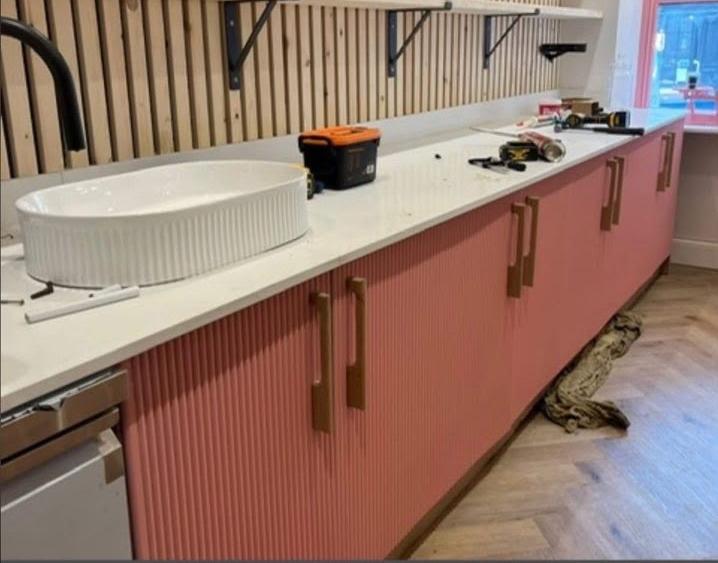
We carry out commercial fit-outs for office, retail and hospitality units, including bespoke bar counters and back-bars, like the timber bar and back-bar fit-out in our projects. Send us the drawings or a description of the unit and we'll set out which approvals it needs and what can run alongside the build. Fitting out a kitchen at home is a different job; for that, see how long a kitchen renovation takes.
Common questions
It depends on how much is changing. A refresh of the dining room and bar within the same layout is mostly building time. A new layout or a new commercial kitchen brings in building regulations, which has a decision period of up to 5 weeks for a full plans application. A change of use, such as turning a shop into a bar, usually needs planning permission, which is decided within 8 weeks in most cases. Those periods can run at the same time, but they set the earliest realistic opening date.
Shops and restaurants or cafés are both in Use Class E, and a change within the same use class isn't treated as development. Pubs, wine bars and hot food takeaways are outside Class E, so turning a shop into one of those generally needs planning permission. External work, such as a new extraction flue, can need permission either way. Check with the council before you sign a lease.
Allow at least 28 days from the date the council receives the application. That's the minimum period for representations, and the notice at the premises has to stay up for 28 consecutive days. If no one makes a relevant representation, the council must grant the licence. If someone does, it goes to a hearing, which adds time.
At least 28 days before you start trading, with the local council. It's free and it can't be refused. The guidance is not to register too early, but around 28 days before you plan to open.
A Gas Safe registered engineer who is qualified for catering work. Ask to see their Gas Safe ID card before work starts: the back of the card should show Catering under Non-Domestic, and natural gas or LPG to match your supply.
Related to this guide
The commercial work this guide is about, and where to read on.
Read next